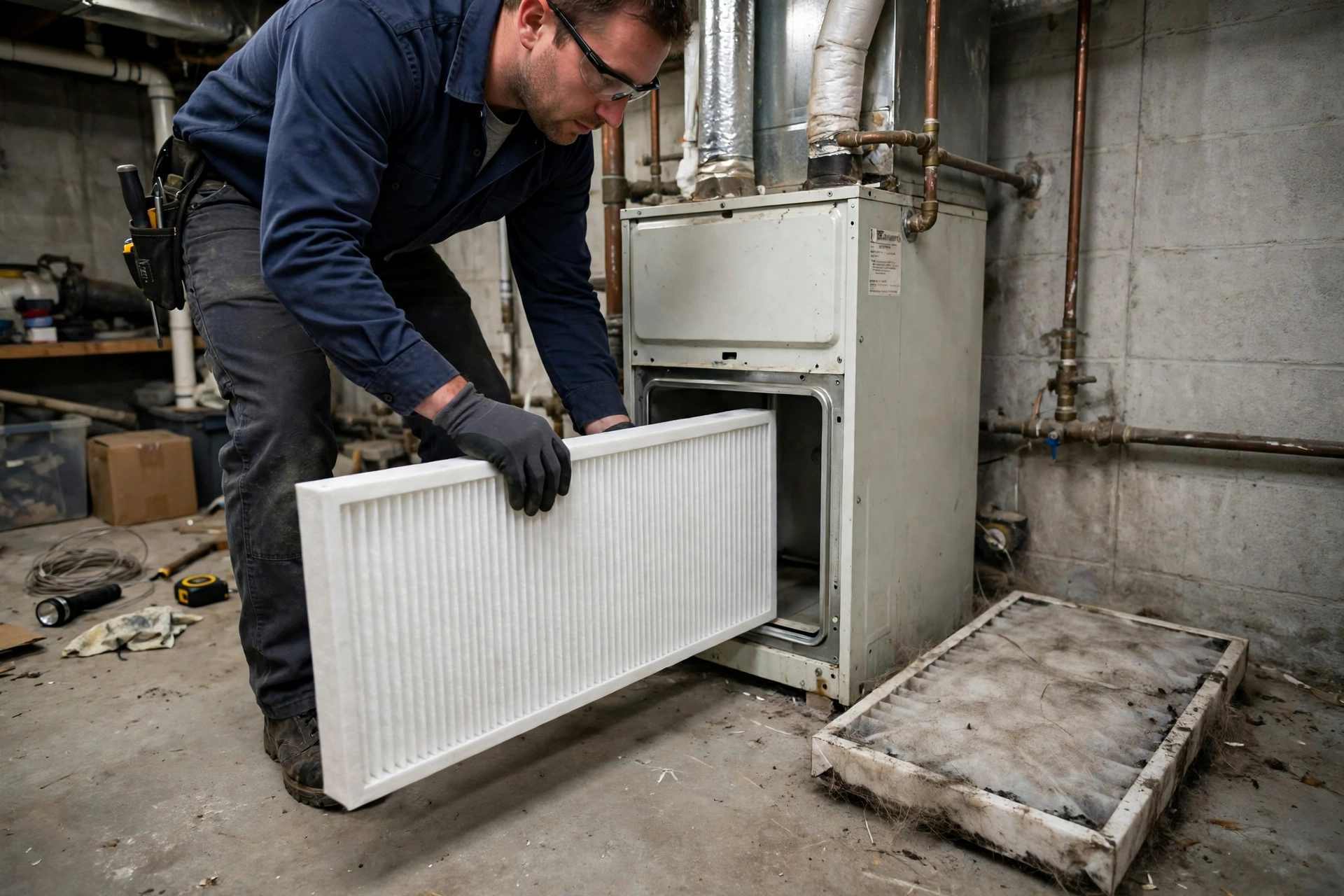
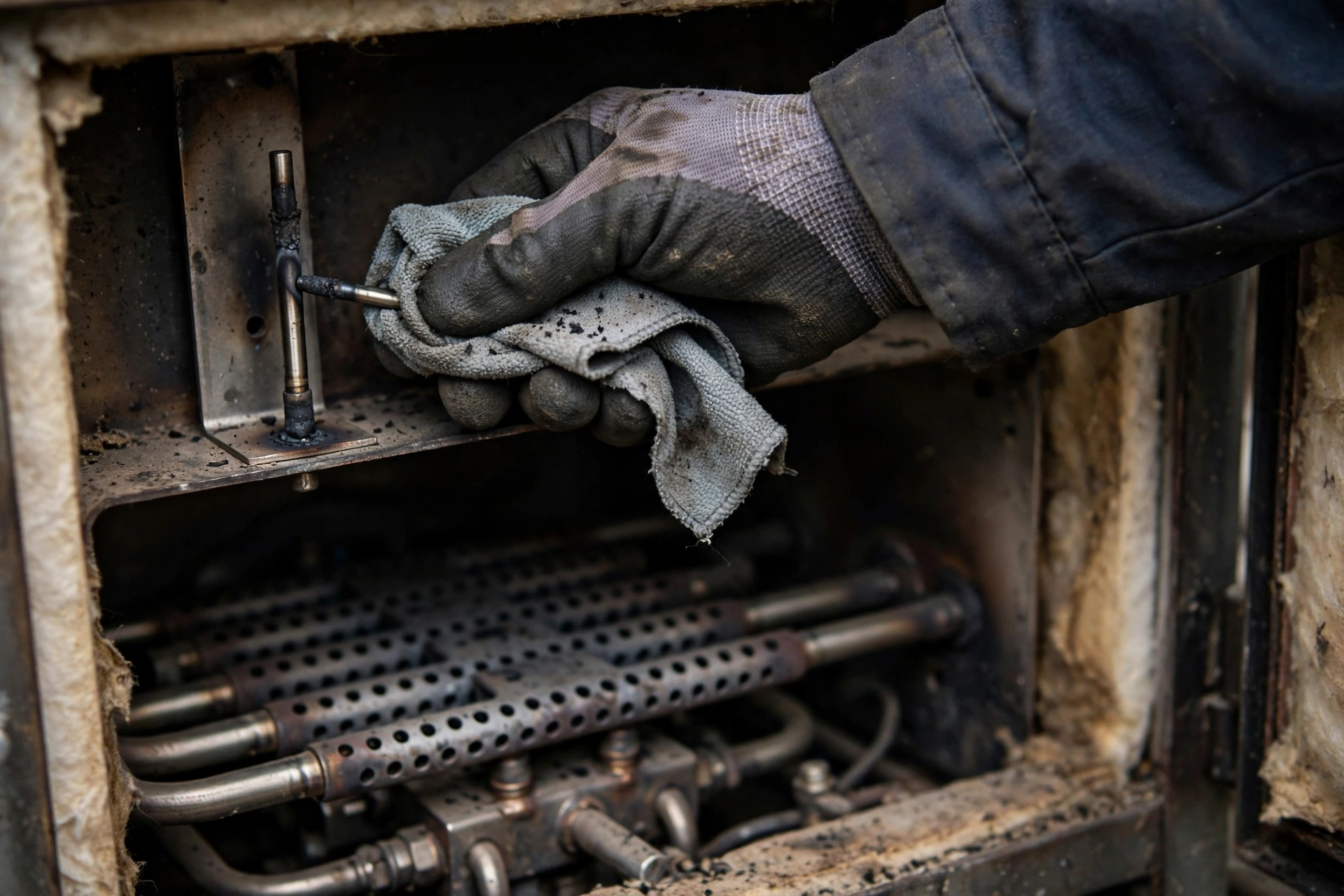
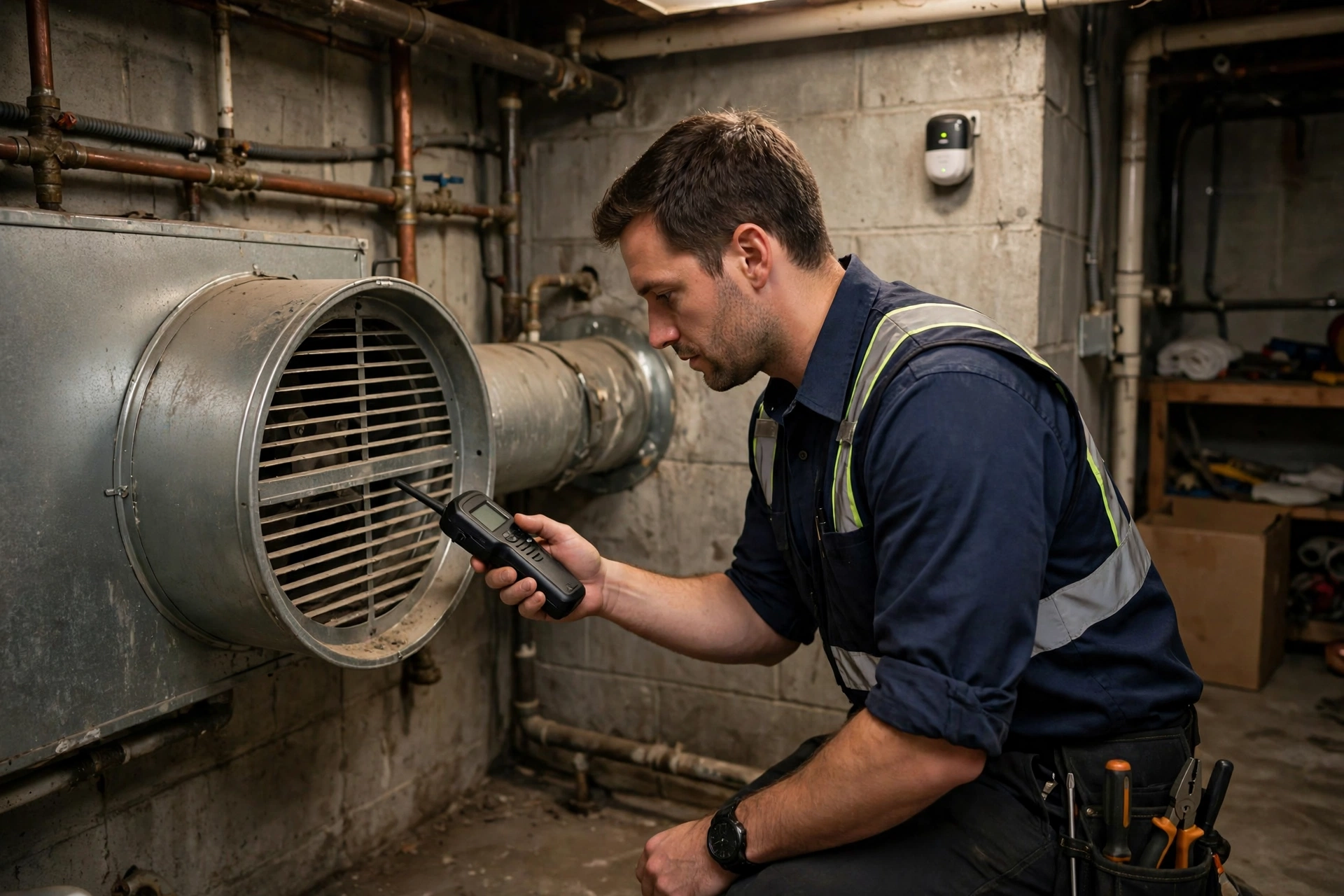
A furnace that runs all winter deserves one careful visit before winter starts. Our maintenance, tune-up, and safety inspection covers the whole furnace — burners or elements, ignition, heat exchanger, blower, controls, venting, and carbon monoxide testing — so small faults are found in mild weather instead of on the coldest night of the year.

The visit follows a sequence, not a glance. Burners are cleaned and their flames checked; ignition parts — ignitors, flame sensors, sequencers on electric models — are tested; the heat exchanger is inspected with mirrors and lights; the blower is checked for bearing wear, capacitor health, and a clean fan wheel; the filter is inspected and changed where the homeowner keeps spares; and the vent route and combustion air are walked end to end. Each check has a reason, and each finding is explained as it is found.
Testing closes the visit rather than opening it. Gas pressure is measured with a manometer, electrical readings with a multimeter, supply-air temperature with a thermometer, and combustion with an analyser that reports carbon monoxide and efficiency indicators. Those readings are the visit's evidence: they show whether the furnace is running as designed, or whether an adjustment is needed. Fuel-specific detail lives on our gas, electric, and propane pages, and the visit draws on all three where the home's fuel requires it.
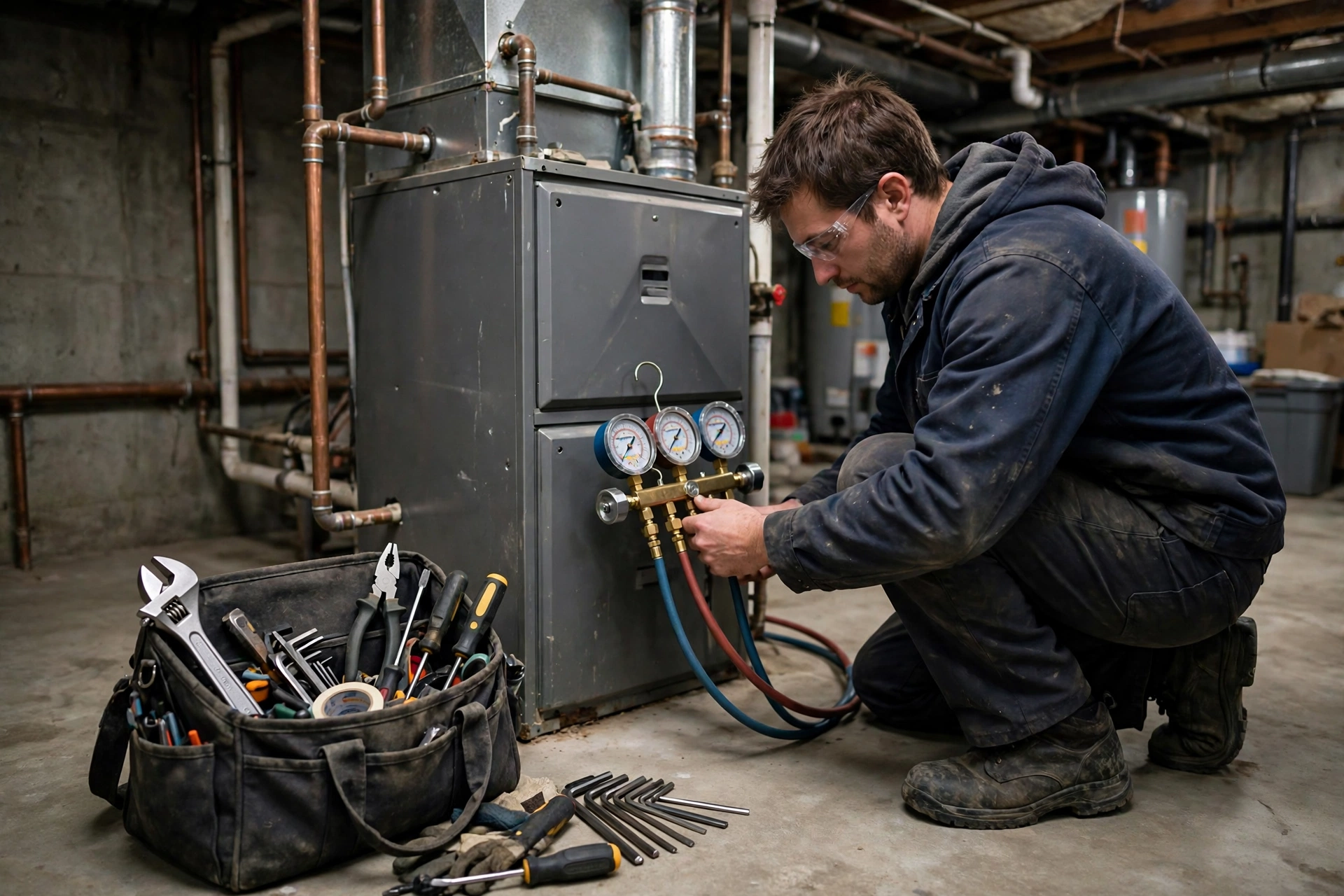
The safety inspection is the reason the visit is called an inspection and not merely a tune-up. The heat exchanger is checked for cracks and corrosion, because it is the wall between exhaust and home air. The vent is checked for disconnection, corrosion, and blockage, including ice at side-wall terminations during cold weather. Carbon monoxide is measured in the flue gas and around the furnace, and the home's alarms are discussed — where they sit, whether they are in date, and whether bedrooms and the furnace room are covered.
Safety controls are proven, not assumed. The limit switch must shut the burners or elements down if the cabinet overheats; the pressure switch must confirm the vent path before ignition; the flame sensor must prove a flame before the gas valve stays open. Each is tested in sequence, because a safety control that has never been tested is a hope, not a protection. Where a check fails, the furnace stays off until the fault is understood — a rule that applies equally to heat exchanger findings and to vent or control failures.
St. Cloud's climate gives this visit its timing. With a heating season running roughly October to April, and a January mean temperature of 11.8°F on the 1991–2020 St. Cloud State University normals, a furnace here works harder and longer than in most of the country. An autumn visit — September or October, before sustained cold — catches the faults that a summer's idleness and a winter's wear together produce, while there is still mild weather to fix them in.

A tune-up also protects the parts a homeowner never sees. A clean filter lets the blower move air easily, which keeps the heat exchanger or elements within their design temperatures and keeps the limits from tripping. A clean fan wheel moves more air with less strain, and balanced dampers share that air fairly between rooms. None of this is dramatic work, and all of it extends the life of the parts that are dramatic to replace.
Efficiency follows from the same checks. A burner adjusted to its proper gas pressure and air mix burns cleanly; an element bank staging correctly heats steadily without overshoot; a blower moving the right volume of air carries the heat the furnace makes into the rooms instead of leaving it in the cabinet. If airflow is the limiting factor, our ductwork and airflow service and our blower motor work cover the fan and duct side in full.
In order, every visit.
Burners, ignition parts, fan wheel, and filter are cleaned and inspected first.
Limit, pressure, and flame-sensing controls are proven in sequence.
Gas pressure, electrical readings, airflow, and combustion are measured and adjusted.
Every finding is explained, with ageing parts flagged before they fail.

Two habits carry the furnace between annual visits: changing the filter on schedule, and keeping supply registers open and return grilles unblocked. A third habit costs nothing and catches trouble early: noticing change. A new noise, a room that cools, a furnace that cycles differently, or an alarm that sounds — each is worth a call sooner rather than later, because faults found early are smaller faults.
If a fault does appear between visits, the relevant service page explains what to expect: thermostat and zone problems, manufactured-home particulars, or commercial scale work. And when the furnace itself is ageing past the point where annual care keeps it reliable, our installation and replacement page covers how that decision is weighed — with the maintenance record as evidence, not guesswork.
One visit, every part of the furnace. The table below is the shape of a tune-up and safety inspection.
| Area | What is done |
|---|---|
| Burners | Cleaned so the flame burns blue and steady |
| Ignition | Tested rather than guessed — ignitor draw and flame sensing |
| Heat exchanger | Inspected for cracks, rust, and soot |
| Venting | Route checked for corrosion, joints, and blocked terminations |
| Filter and airflow | Filter changed and airflow checked across the system |
| Safety controls | Limit switches and safety shut-offs tested |
| Combustion test | Flue-gas readings confirm clean running |
A tune-up follows the same order every season, so nothing is skipped when the weather is still mild.
Early autumn — September or October — is ideal, before sustained cold arrives and while faults can be fixed in mild weather. A furnace that has sat idle through summer can develop ignition, sensor, and vent problems that only show on first firing, and an autumn visit finds them before the heating season depends on the unit.
A safety inspection covers the heat exchanger for cracks and corrosion, the vent route for blockage and disconnection, combustion and carbon monoxide testing, and proof-testing of the limit, pressure, and flame-sensing controls. It also reviews carbon monoxide alarm placement and dates in the home.
It prevents many of them. Cleaning, testing, and adjustment catch worn ignitors, weak capacitors, dirty burners, and airflow faults while they are still small, and safety testing catches exchanger and vent problems before they become hazards. No visit can promise a winter without a breakdown, but a maintained furnace fails far less often.
Call Quarry Furnace Co. about your furnace — repair, replacement, and tune-ups in St. Cloud and the towns around it.
(320) 389-8174Answers about the annual visit and what it finds.
Once a year, before the heating season, is the usual rhythm for any fuel type. Homes with older furnaces, longer run hours, or a history of faults benefit most from keeping that rhythm without skipping a year.
A tune-up cleans, tests, and adjusts the furnace for reliable running; a safety inspection proves the protections — heat exchanger, venting, carbon monoxide levels, and safety controls. Our visit does both, because a well-tuned furnace still needs its safety boundary proven.
Yes — it is the most useful homeowner job, and we show you where the filter sits and what size it takes during the visit. Changing it on schedule protects airflow, the blower, and the heat exchanger alike.
A clean burner, correct gas pressure, proper staging, and healthy airflow let the furnace deliver its designed heat with less wasted run time, which usually shows up as steadier comfort and less strain. The size of any saving depends on the furnace's condition before the visit.
Yes — gas, electric, and propane furnaces are all covered, with fuel-specific checks for each: burners and combustion on gas and propane, elements and sequencers on electric, and the shared checks on blowers, exchangers, controls, and airflow.
The furnace stays off until the fault is understood and the options are explained — exchanger or vent problems, failed safety controls, and dangerous carbon monoxide readings are not conditions to heat through. We explain the findings plainly and the realistic next steps.
The full annual visit: clean, test, adjust, and prove the safety controls.
(320) 389-8174