The house is cooling, it is the middle of the night, and the furnace will not run. Work through this order: basic checks, pipe protection, and the call that gets help fastest.

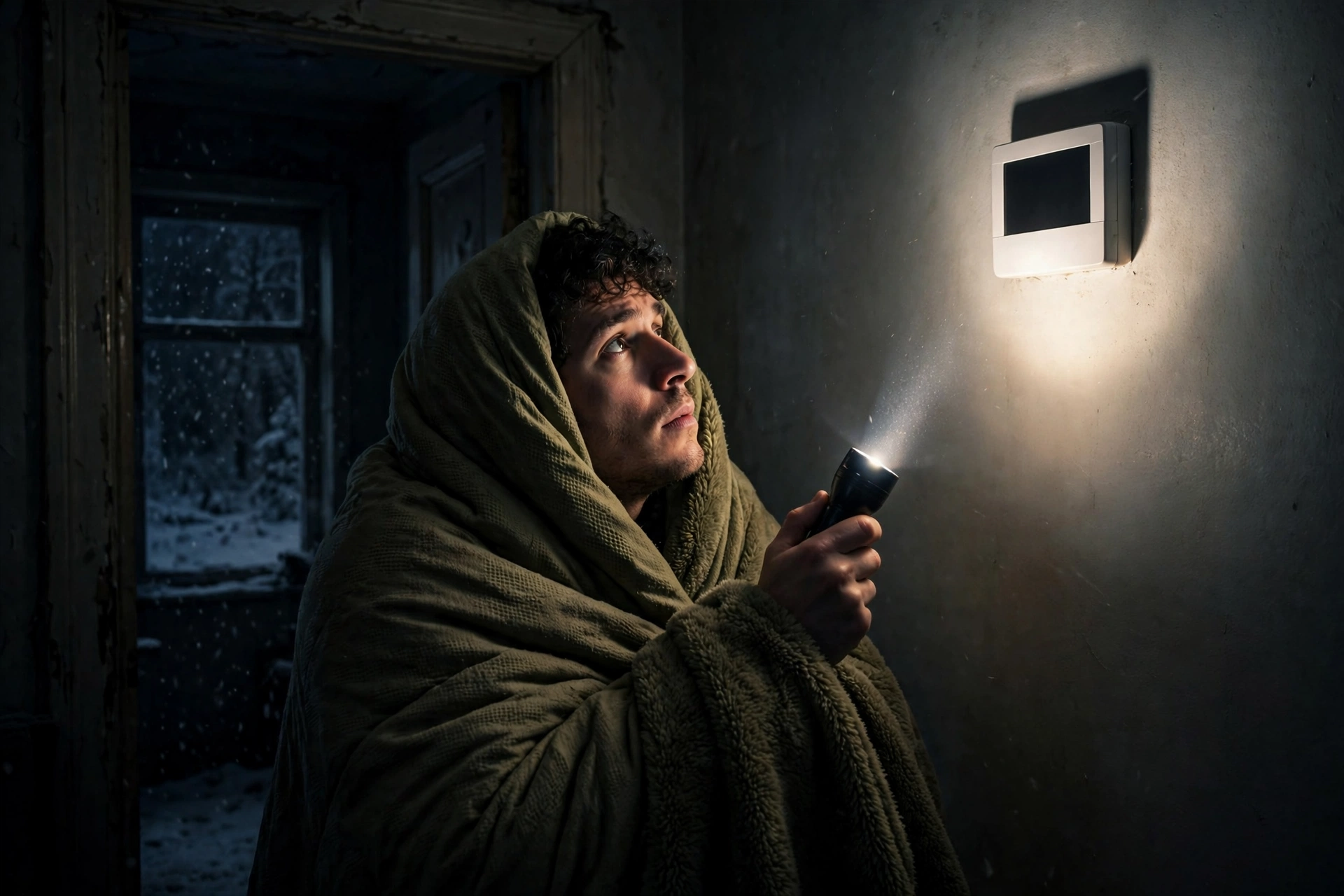
Wake up to a cold house and the instinct is to panic or to start pressing buttons. Do neither first. Check the thermostat: is it set to heat, is the setting above the room temperature, and are its batteries fresh if it uses them? Check the furnace power switch and the breaker panel with a flashlight. Check the filter only if you can do so safely and quickly — a clogged filter is a common cause, but fumbling in a dark basement is not the time for a thorough inspection.
If the furnace has a small window showing an error code, note the code without opening the cabinet. Try one reset, by switching the power off and on once, if the furnace has locked out. If it locks out again, stop resetting: a repeated lockout means the furnace is protecting itself from a fault that needs diagnosis, and our January cold-snap post explains that safety logic in full. If you smell gas, or a carbon monoxide alarm sounds, leave the house and call for help from outside — those two signs override every other step in this post.
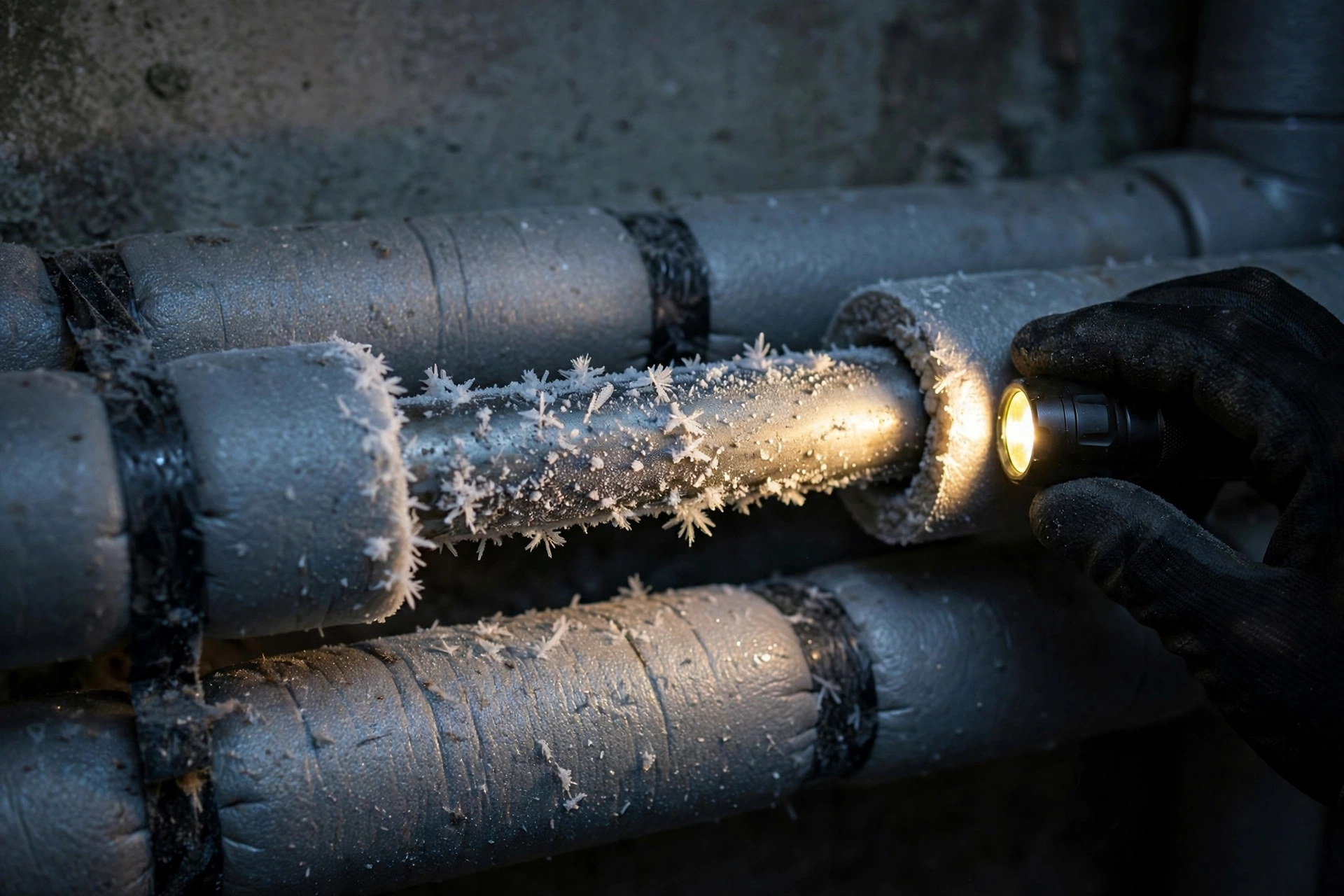
A house does not cool evenly. Rooms on exterior walls, rooms over unheated spaces, and rooms at the far end of long duct runs cool fastest. Pipes freeze first where they sit in or against exterior walls, in unheated basements and crawl spaces, and in cabinets under sinks on outside walls, where cold air reaches the pipe and warm house air does not. A pipe does not need the whole house to reach freezing; it needs its own small pocket of air to drop low enough, for long enough, for still water inside it to turn to ice and expand.
That expansion is what breaks pipes: ice takes up more space than water, pressure builds between the ice blockage and a closed tap, and the pipe splits. The split often shows only when the pipe thaws and water runs, which is why a frozen pipe can look harmless at night and flood a room in the morning. Knowing where your vulnerable pipes are — before a breakdown — is the single most useful piece of preparation in this post. Walk the house in daylight sometime and note the pipes on exterior walls, in the basement near the foundation, and under sinks on outside walls.

Start with water movement: open one tap, preferably the one furthest from where water enters the house, to a slight drip. Moving water is far less likely to freeze than still water, and a drip relieves pressure if ice does form. Open cabinet doors under sinks on exterior walls so warm room air reaches the pipes inside. Close off unused rooms and shut their doors, concentrating the remaining heat where people and pipes are.
If you know a particular pipe is vulnerable — an exterior-wall sink, a basement run near the foundation — wrap it in a towel or blanket as a temporary measure and keep its cabinet open. Do not use a torch, a heat gun, or an open flame on a frozen pipe; if you find a pipe you believe is frozen, and you can reach it safely, gentle warmth from a hair dryer, aimed along the pipe rather than at one spot, is the usual homeowner approach, with the tap open so melting water has somewhere to go. If a pipe has burst, shut the water off at the main valve, which is another location worth knowing before you need it in the dark. For the space-heater side of a cold night, read our post on furnaces versus space heaters — portable heat helps the room you sit in, but it does not protect distant pipes.

When you call, lead with the facts a technician needs: the furnace symptoms, any error code you noted, what the thermostat shows, what you have already checked, and whether the house has vulnerable pipes or any sign of a burst. Say which town you are in, and be honest about driveway and road conditions if the weather is bad. A call that starts with diagnosis, rather than with a general “it's broken,” lets the visit start faster and with the right parts and tools in mind.
While waiting, keep the house's heat where it matters: one or two occupied rooms with doors closed, pipes protected as above, and no improvised heating. Do not use the oven or a gas range as a heater, do not bring a grill or generator indoors, and do not leave a portable heater running unattended or while you sleep. Those rules are hardest to follow at 2 a.m. in a cold house, and they matter most then. You can reach us from our contact page, and the same night-time pattern applies in Sauk Rapids, Sartell, and every town around St. Cloud.
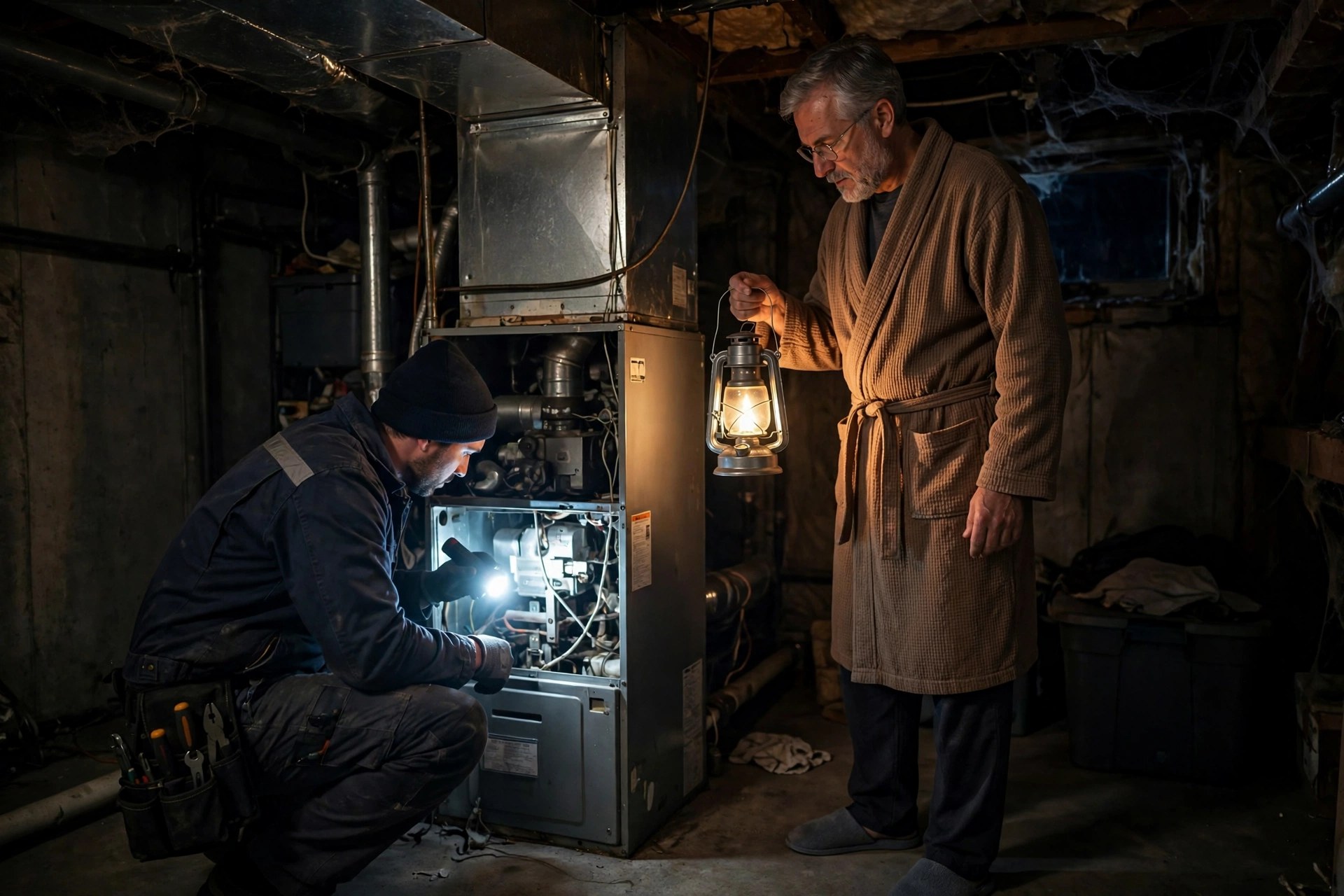
When the furnace runs again, do not assume the night is over. Walk the house and check every tap: a tap that gives only a trickle, or nothing at all, may have a frozen section still to thaw, and a tap that runs normally everywhere is the best sign the pipes survived. Look under sinks and along basement pipes for drips, damp patches, or the sound of running water where none should be. A split pipe can leak slowly at first, and catching it before morning limits the damage.
If a pipe is frozen but not burst, keep its tap open and apply gentle warmth along the pipe until flow returns fully, then watch it for leaks as it thaws. If a pipe has burst, keep the water off at the main valve and call for plumbing help as well as furnace help — the two jobs are separate, and both matter. The next day, raise the night's pattern at a tune-up and safety inspection: a furnace that fails at night in January usually gave smaller warnings earlier, and catching them in autumn is the whole point of that visit.
The best time to prepare for a 2 a.m. breakdown is a calm afternoon. Find the main water valve and make sure it turns. Find the furnace power switch, the breaker, and the filter slot. Note the thermostat battery type. Learn where the vulnerable pipes are. Write the technician's number where the household can find it without a phone search in the dark. Each of those takes minutes in daylight and saves confusion at night.
Add the vent check to that daylight walk: find the furnace vent pipes on the outside wall, so a night-time check of snow-blocked vents is a known route rather than a search. Our pre-first-freeze checklist and our post on vent freeze-ups cover that routine. A household that knows its valve, its switch, its filter, and its pipes is a household that can protect itself through the hours until help arrives.
There is no fixed time, because it depends on the outside temperature, the house's insulation, and where the pipe sits. Pipes in exterior walls, unheated basements, and cabinets on outside walls can freeze in hours on a cold night, while pipes in interior walls may last longer. That variation is why pipe protection starts immediately, not after waiting to see.
Yes, a slight drip from one tap, preferably the furthest from where water enters the house, keeps water moving and relieves pressure if ice forms. Moving water freezes far less readily than still water, and a drip is a cheap, effective bridge until heat returns.
Never use an oven, a gas range, a grill, or a generator indoors as a heater, never leave a portable heater running unattended or while you sleep, and never keep resetting a furnace that locks out repeatedly. If you smell gas or a carbon monoxide alarm sounds, leave the house and call from outside.
Call Quarry Furnace Co. about your furnace — repair, replacement, and tune-ups in St. Cloud and the towns around it.
(320) 389-8174Answers about this topic, in plain language.
Check the thermostat setting and mode, the furnace power switch, and the breaker, and note any error code visible without opening the cabinet. Those checks take minutes and solve a number of night-time callouts. If the furnace locks out again after one reset, stop resetting and call a technician.
A tap that gives only a trickle or nothing at all, while other taps run normally, points to a frozen section feeding that tap. Frost on a visible pipe, or a bulging section, is another sign. Keep the tap open and apply gentle warmth along the pipe until flow returns, watching for leaks as it thaws.
Shut the water off at the main valve immediately, then call for plumbing help as well as furnace help. Mop up water where you can, keep the affected area clear, and do not restore water until the burst section has been repaired, because pressure will find the split again.
Only the pipes in the room it heats, and only while it runs attended. A portable heater in the living room does nothing for pipes in a far bedroom, a basement, or a cabinet on an exterior wall. Whole-house pipe protection comes from the furnace, plus dripping taps and open sink cabinets.
Not unless a pipe has burst or is leaking. Keep the water on with a tap dripping, so pressure is relieved and thawing water has somewhere to go. Shut it off at the main valve only if you find a burst, a leak, or a pipe you cannot keep from freezing.
In daylight, find the main water valve, the furnace power switch, the breaker, and the filter slot, note the thermostat battery type, learn where the vulnerable pipes are, and write the technician's number where the household can find it in the dark. That preparation turns a 2 a.m. emergency into a series of known steps.